Tips for Teaching Patience

My mother in law often jokes that years ago, she could never tell her youngest son about any plans for outings or family trips in advance because he would drive her crazy with questions every 5 minutes about when they could go. I’m sure we can all relate. Imagine a child who loves nothing more than a good trip to Wal-Mart, and then consider that this child has no concept of the passing of time. Mentioning that trip to Wal-Mart too early in the day could be regrettable. Being asked to wait without the ability to understand how, when, and why is extremely difficult for some young ones and people with learning challenges. Not to mention the times when you, as the adult, intend to run to Wal-Mart, but plans change. The level of disappointment is a lot for a child to cope with when it was going to be the highlight of their day. Luckily, there are some easy ways that you can teach a child to wait and increase your child’s ability to cope with unexpected changes that can be embedded into your daily routines.
Timers
Timers are a great way to encourage understanding of the passing of time. You can use a timer on your phone, stove, or microwave; use a digital timer, a rotating mechanical kitchen timer, or even an hour glass. You can introduce the timer gradually by using it a few times a day. Begin by timing out events that are routine, short term, and not too exciting. It could be something simple like announcing that in 5 minutes it will be bath time. You can tell your child that you are setting a timer for bath time, but try not to put too much emphasis on it at first. It should be something that you are doing in the background just to create exposure. As the child shows interest, you can teach more about the timer, but I would not put pressure on the child to stop what they are doing and come set it early on.

Important: For best results, you should be ready to start bath time (or whatever event the timer may trigger) immediately when that timer goes off. As the child begins to show understanding, you can increase the length of time and begin to time out more stimulating events. Timers not only create a concrete way for children to experience the passage of time, but they also teach patience because kids can’t ask a timer to hurry up. They will come to accept the implied authority of the timer and learn that the passing of time is out of their control. Understanding how a timer works is a gradual process, but when he or she gets to a certain point of understanding, you can say, “we are going to the park in an hour,” and have your child set the timer. With understanding and taking control of that process comes the ability to cope with the delay of gratification.
Compliance Tasks
No one likes waiting, but waiting when there is nothing to occupy your mind is especially difficult. It is beneficial to give your child something to do while waiting because it can help them cope while also creating some pride in responsibility. As with the timer, I would embed this into routines early on. Choose times during the day when you are about to engage in a desired activity and add a compliance task immediately prior to the desired activity. In this situation, a compliance taskis a quick and easy chore that a child can complete right before the fun activity. For example, your toddler is looking forward to reading a book with you. Just before choosing the book you say, “but first, put your shoes away.” A compliance task does not always have to be a traditional chore. It can be any task that has a clear beginning and ending, like completing a puzzle.
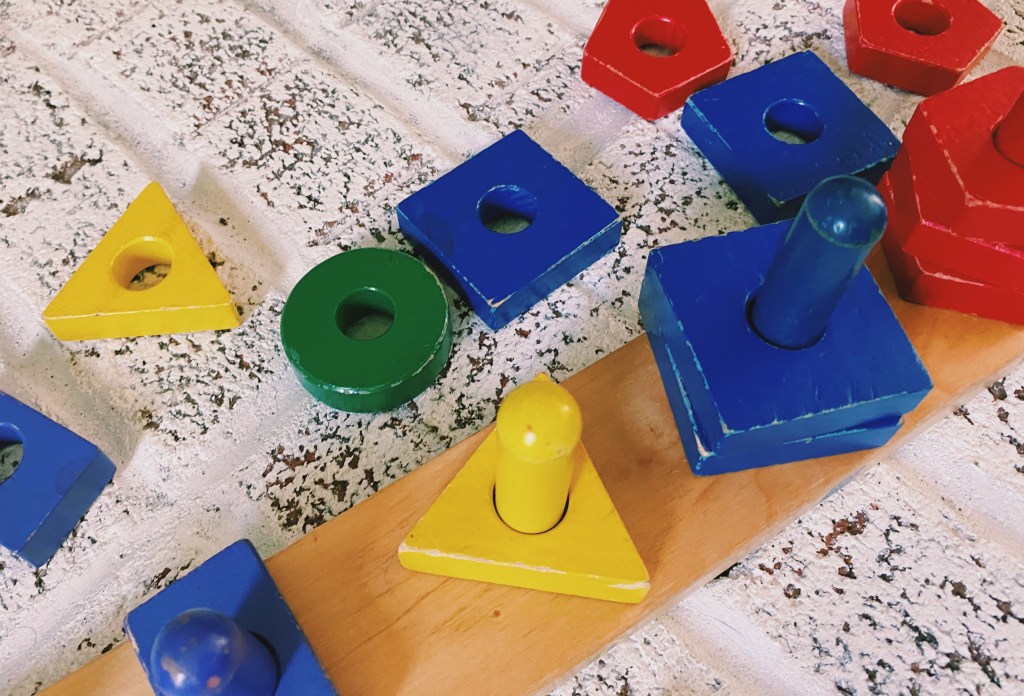
In the beginning, the compliance task should be something nearby and very easy for the child. When they complete the task, reward them with praise, hugs, etc. It is best to start by doing this several times per day in low stress situations. As they begin to understand and go along with requests for these compliance tasks, you can begin to challenge them with greater tasks. This is a gradual process, but over time it can grow into, “we will go to the park after you clean your room.” Important: For best results try to remain firm, but very positive. Only request a compliance task when you know you will be able to follow through. Once you have named a compliance task, carry it out even if persuasion is required. You may help your child if absolutely necessary, but do not complete the compliance task for them.
Busy Boxes
Some children and developmentally disabled people struggle to entertain themselves independently, even when they are not waiting for an anticipated special event. A busy box can help! A busy box is a box or bag of high interest, with desired items that remain novel because they are only available occasionally. What you put in the busy box depends on the child who will be using it or where you will use it. You may want to have several busy boxes. You can have one for long car rides, one for waiting for your food at a restaurant, one with sensory activities, one with arts and crafts, one for grandma’s house, etc. The possibilities are endless, but you can be successful with just one. An important thing to remember with the busy box is that all items included should be things that the child can use independently. Try to stay away from messy things like paint or markers.
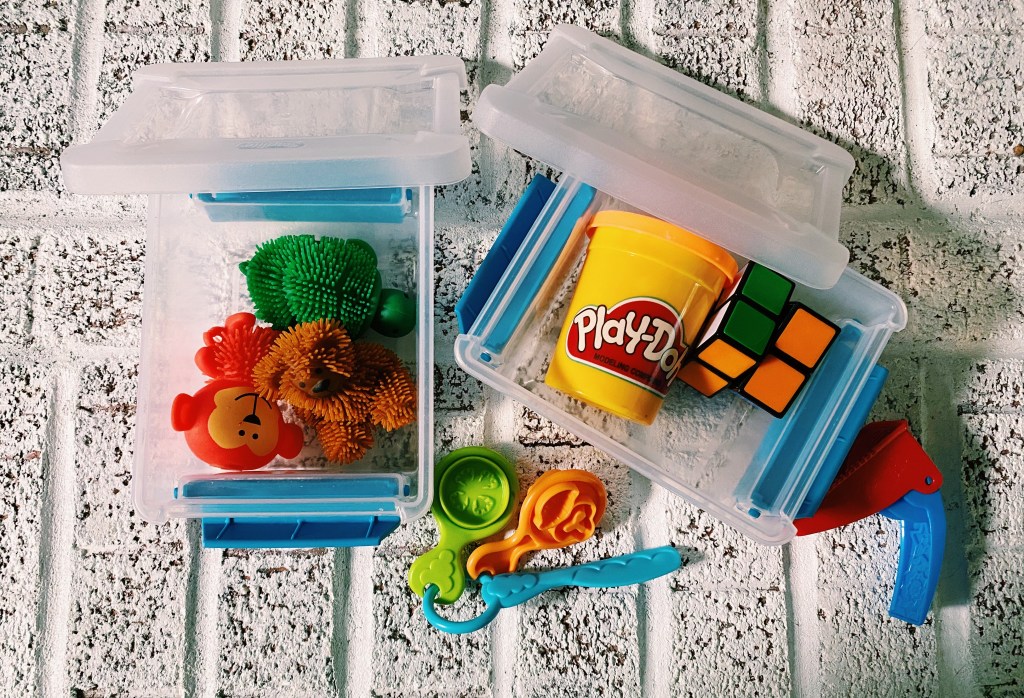
It is a good idea to have a structured play session with your child and introduce the items in the box. Use this time to model some fun ways to use the items. Important: The busy box should have some rules. It should be kept separate from other toys or games. It should be out of reach and sight if possible. Try to impress upon your child that the busy box is special and will be used in a special area (on outings, at the kitchen table). Do not let the busy box go into the playroom, toy box, or anywhere that the child could use it when they choose. It is important to be consistent.
Visuals
Another valuable tool in teaching patience, waiting, and coping is the use of visuals. For the purpose of this article, visuals are simply pictures, symbols, or words that can be used as a schedule. Adults rely on visuals everyday in the form of lists and calendars. This is another concrete way to teach the passage of time. You can use a variety of materials to make a visual list or schedule for your child. Words on a chalkboard, dry erase board, or piece of paper all work great for children that can read or understand sight words. Pictures or PECS (Picture Exchange Communication System) symbols can be used for pre-readers. An easy way to introduce a visual schedule is a first & then board. A first & then visual will often have two pictures. Each picture symbolizes an activity. First & then is ideal for younger children or anyone who might be overwhelmed when presented with too many steps. A more sophisticated visual with multiple steps can evolve over time as the child develops understanding. A visual schedule can be as simple or as complicated as you wish to make it within the parameters of what your child can comprehend.
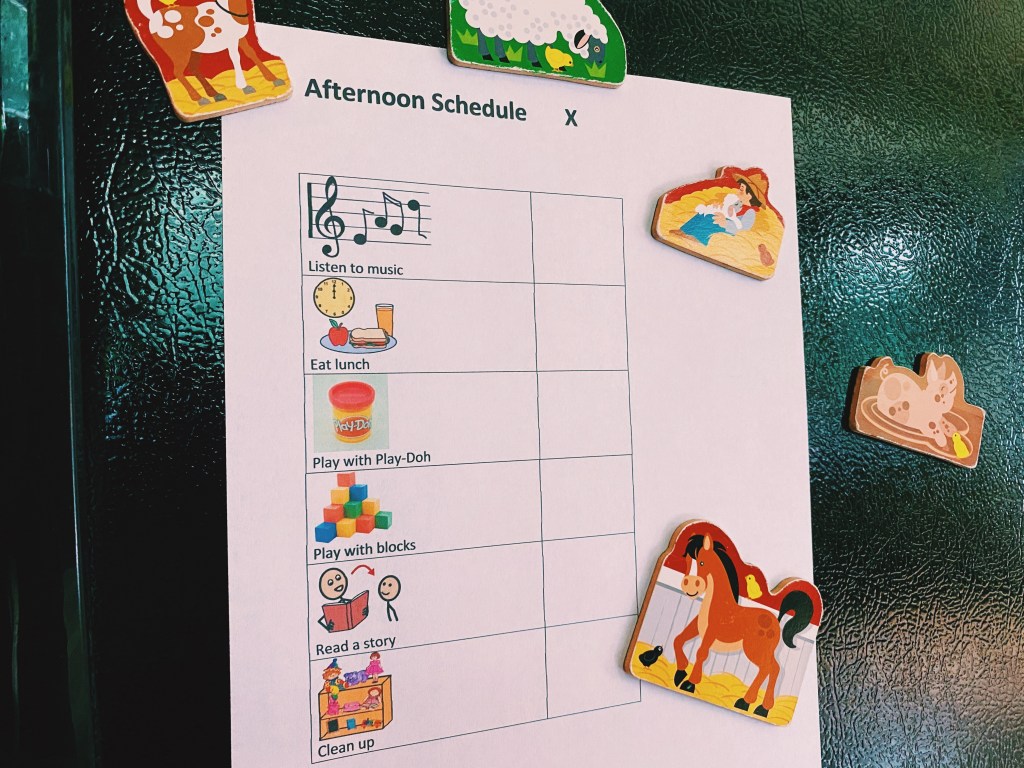
In classrooms, we often utilize specific symbols that are laminated and Velcroed to a board or folder. Office supply stores will laminate items for a price, and Velcro can be easily found online or at a variety of stores if you wish to make this type of board. You can also find printable schedules for purchase on Teachers pay Teachers and Etsy. However, at home, pictures or symbols printed on the computer can be just as effective. Pictures can be posted with tape, magnets, or pins on a cork board. For best results, call the child’s attention to the picture schedule as you post it. Explain what activity each picture symbolizes. Throughout the day, as each task is successfully completed, remove or cross out the symbol that represented that event to clearly signify that it has been completed. Important: For best results, be consistent. Set it up with the child, and then remove each piece with them as soon as the task is completed. The child should gain a mastery level of understanding how the schedule works before using it independently.
These are just a few ways to teach self control and waiting. It definitely helps to start young. Very young children can learn to wait without resorting to tantrum behavior if they have been taught to cope with waiting all along. If you use the tools above and make it a point to manufacture opportunities to wait for short increments throughout your daily routine, it will empower your child with the ability to wait patiently when situations occur that are out of your control.
Good luck and thanks for reading!
 Win @ Parenting